

Education is tasked with preparing learners for a future that no one can fully predict. That tension raises an important question: if the future is unknowable, why spend time thinking about it? For communities like the Long Now of Education, futures thinking is not about predicting what comes next; it’s about expanding what we believe is possible.
Applying Long-Term Thinking to Education
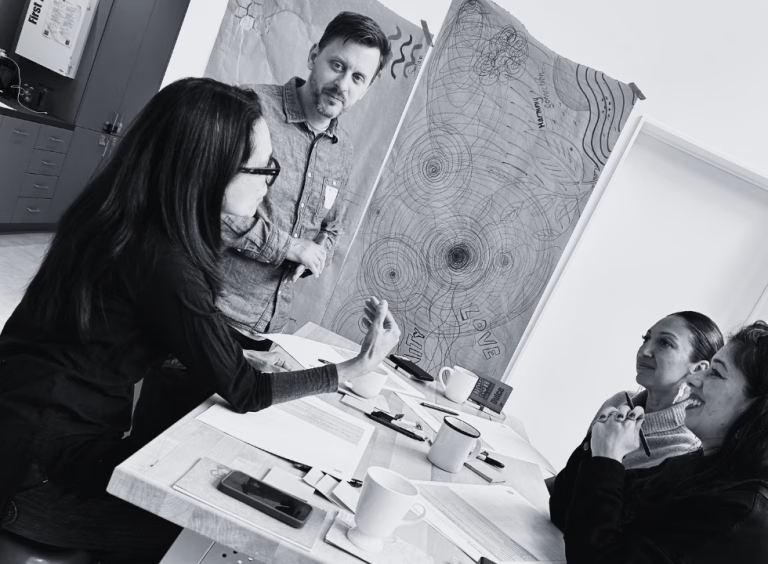
I recently had the privilege of joining the Long Now of Education community in Oakland, California, for its 02026 gathering. The Long Now of Education brings together practitioners from a wide range of fields who share an interest in applying long-term thinking to education. Together, they challenge themselves to look beyond school-year cycles and immediate pressures, considering instead how today’s decisions might shape learning across generations. In doing so, they question inherited assumptions about how and why education operates while exploring new possibilities for the future of learning.
Over two days, participants engaged with tools and perspectives for thinking about long-term futures. Together, we examined the influence of “used futures” and other inherited narratives and worked with David Clifford using Liberatory Design to develop prototypes aimed at advancing a future of learning grounded in dignity.
Fittingly, the gathering embraced uncertainty rather than attempting to eliminate it. While thoughtfully structured, it left ample room for conversations and emerging questions to shape the experience. In small groups, we wrestled with the future and translated our ideas into both prototypes and personal commitments.
Creating a More Dignified Future of Learning
My group developed a learning ritual called Know and Tell, inspired by the familiar practice of show-and-tell. Instead of asking learners to present something they have, the ritual invites them to share something they know. Over time, this simple practice could help cultivate a more dignified future of learning by giving young people agency, recognizing them as contributors to knowledge, fostering inclusion and creating opportunities for meaningful connection among peers.
In addition to Know and Tell, I left with a personal commitment aimed at shaping the future. In a world increasingly mediated by screens, I want to be more present, spending less time online and more time in face-to-face conversations and relationships. If a dignified future of learning depends on connection, belonging and mutual respect, then presence itself may be one of the most powerful ways we can help shape that future.
The gathering was a powerful reminder that one of the most powerful aspects of futures thinking is about creating the conditions for better possibilities to emerge. In education, where the stakes are measured in generations rather than quarters or election cycles, that work matters deeply. While none of us can know exactly what the future holds, we can choose the values, relationships and practices we carry forward. As I left Oakland, I found myself returning to a simple idea: a more dignified future of learning will be built through curiosity, connection and the collective willingness to imagine and create something better together.
I am already looking forward to Long Now 02027.
Editor’s Note: The Long Now of Education is a movement for transformation and annual convening incubated by Henry Ford Learning Institute.
