

Choosing a college path, preparing for a career, or deciding what comes next in life can feel overwhelming. There is often pressure to have the right answer, the perfect plan, or a clear destination.
Design Thinking offers a different way in.
Instead of expecting people to know exactly where they are headed, design thinking encourages curiosity, experimentation, reflection, and action. It gives students – and the educators who support them – a practical way to explore possibilities, learn from experience, and make decisions with more confidence and intention.
What is Life Design?
That idea is at the heart of Life Design, an approach developed by Stanford University educators Bill Burnett and Dave Evans. Their course for young adults grew into the bestselling book Designing Your Life and has since influenced student success work at hundreds of colleges and universities.
Life Design applies Design Thinking to some of life’s biggest questions: What do I care about? What kind of work gives me energy? What possibilities might I try? What can I learn by taking one small step?
At HFLI, those questions feel very familiar. For almost 20 years, we have partnered with K-12 schools, colleges, universities, and community organizations to create deeper learning experiences grounded in Design Thinking. Across that work, we have seen how powerful it can be when learners are invited to build skills such as critical thinking, creative problem-solving, collaboration, leadership, and empathy — not as abstract concepts, but as durable skills they can use in real decisions and real situations.
That is why we were excited to join colleagues from across higher education at the inaugural Bowling Green State University Life Design Convening, hosted by BGSU’s Geoffrey H. Radbill Center for College and Life Design on May 15-16, 2026.
How Can We Work Together with Purpose and Joy?
The convening brought together 120 representatives from 27 colleges and universities across North America. Participants came ready to share ideas, compare approaches, and learn from one another about how Life Design is taking shape on campuses.
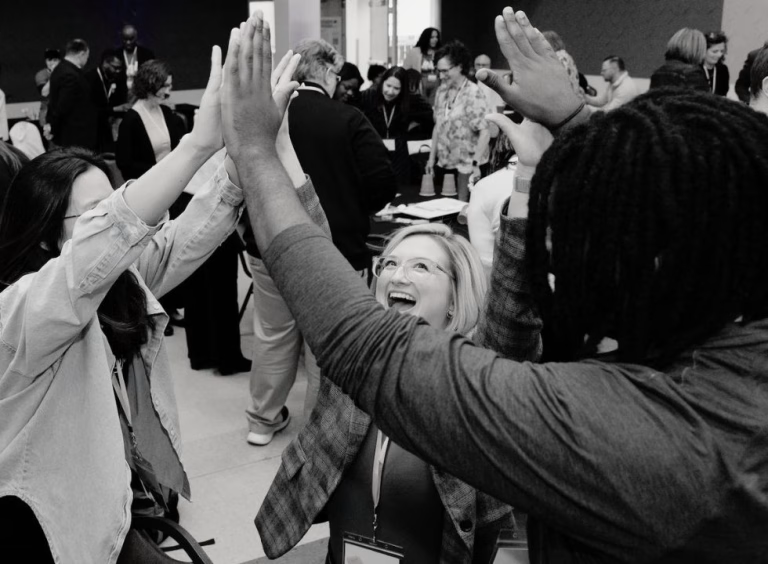
HFLI’s Deborah Parizek and Theodore Kozerski helped kick off the convening by facilitating a hands-on session called “Building Community and Connection Through Shared Purpose, Shared Work and Shared Joy.”
Our session invited Life Design educators and practitioners to connect through purposeful activities and games that centered fun, trust, vulnerability, and creativity. Participants also created context maps to explore the people, relationships, challenges, questions, and opportunities connected to their Life Design work.
As they shared their maps with one another, participants identified areas for growth and possible next steps to bring back to their own campuses. The room was full of energy, openness, and a shared belief that students need more than information about college and careers. They need meaningful opportunities to explore who they are, what they value, and how they want to contribute.
How Can We Make Sense of What Comes Next?
The convening was also a learning opportunity for HFLI. We heard from leaders working through the challenges and successes of building support for Life Design in higher education. We learned about different implementation models, including examples from Oakland University, Barry College and Dartmouth College. And we were reminded that while each campus has its own context, many educators are asking similar questions about how to better support students in a changing world.
One comment from Bill Burnett during his fireside chat with BGSU President Rodney Rogers captured the spirit of the gathering. Reflecting on the pace of change in higher education and the world of work, Burnett noted that students are looking for frameworks that help them make sense of what they are experiencing and what might come next.
Design Thinking can be one of those frameworks.
It does not promise a straight path or a perfect answer. Instead, it gives students and educators a way to ask better questions, try ideas, learn from others, and move forward with purpose.
For HFLI, that is work worth continuing.
